
Hope From the Margins
By Ahtoy Juliana, July 21, 2026
A friend recently sent an Instagram video labeled "hopecore" to a group chat, with a caption promising it would get us through the day. For those of you older than Gen Z, like me, the "-core" suffix is internet shorthand for an aesthetic, as in normcore. Hopecore emerged a few years ago from niche TikTok trends where people wrestled with the meaning of life. The videos usually tell an underdog story about an athlete, actor, or public figure of color whom mainstream media has overlooked, stitched together over a feel-good tune like Frank Sinatra's "My Way." What began in a small online world has grown enormously popular over the past few years, and that points to a disturbing reality. A broad audience does not develop an appetite for manufactured hope unless it is living inside a broad sense of doom. Many of us, maybe most of us, are carrying some version of that doom, whether we can articulate it or not. We are watching authoritarianism tighten around us, watching our human rights stripped away day after day, watching people we love be abducted from their homes and streets, all while we work ourselves to the bone and still cannot afford the basic materials of a life. Hopecore is intriguing the way other social media trends are intriguing. It reflects something real about what we are going through, it is genuinely compelling to watch, and it also makes me suspicious about what it wants us to believe.
The video my friend sent featured a woman describing her dissertation research on activism and organizing against capitalism and colonialism, and her argument was elegant in its simplicity. There is evidence, she said, for whatever world you want to believe in, so if the choice is between doomerism and hope, choose hope. She quoted the abolitionist Mariame Kaba's now-famous line that hope is a discipline, something we manufacture through action, through showing up to protests and doing the slow work of imagining a different world. Like nearly everyone in the comments, I found her genuinely moving. There is something empowering in treating hope as a muscle rather than a mood, as something built through practice rather than awaited as a feeling. I ate it up. I may or may not have shed a tear, and I was definitely hitting the little airplane button to send it to my most optimistic friend, thanking them for putting up with my constant Debbie Downerism, until I realized… I was the exact person this video was engineered to destroy. And honestly, the video might have kept working on me indefinitely if I hadn't gone dancing last night.
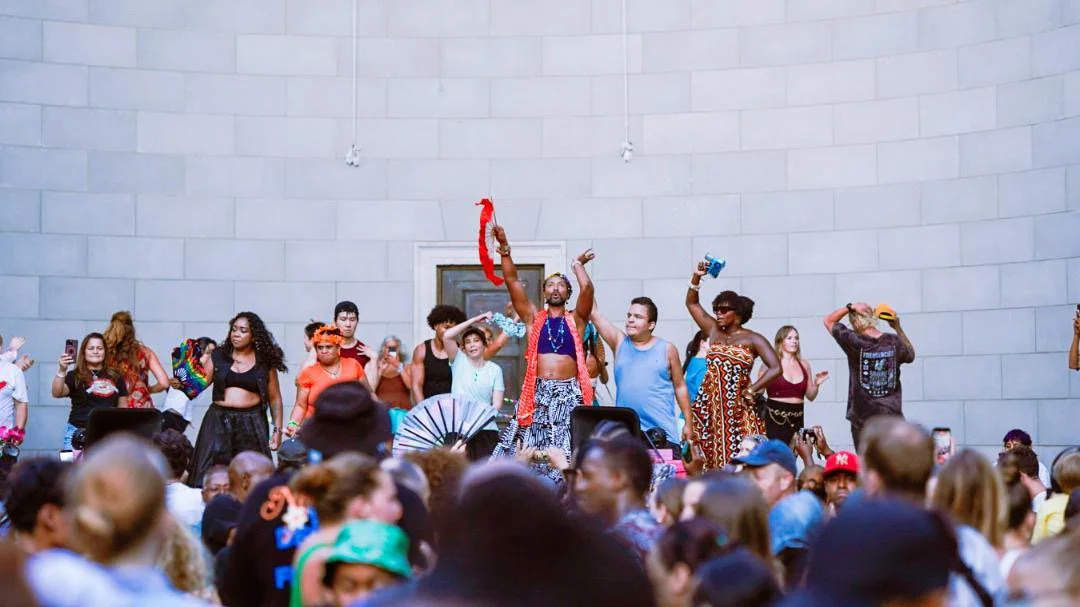
For the past couple of years, Dance Is Life has been making a deliberate effort to open our parties, and all the joy that comes with them, to people with disabilities. This year we went through training with our communities to understand the barriers between a disabled person and the dance floor. Last night I learned what accessibility actually asks of us, and what it gives back: the chance to be in community with people you are rarely around, simply because access doesn’t allow it. We worked with disability doulas, Black and queer women who offer assistance and community care to disabled people. There was ASL interpretation and help with transportation. There was a vibrating platform for deaf attendees, so the music could arrive through their feet instead of their ears, and standing on it made me jump with sheer delight. I kept thinking about how accommodations designed for a specific population end up widening what everyone gets to experience. Joy became something you could receive through vibration as fully as through sound. We are only at the beginning of this work, and already I could see how improving access for disabled people will expand the experience for all of us. I want to be careful here, though, because that expansion is an unanticipated gift of accessibility, but it should never be its justification. We do not make dance floors accessible because able-bodied people happen to benefit. We make them accessible because dance is a human right, because moving your body to music alongside other people is one of the oldest ways humans have transformed despair into joy.
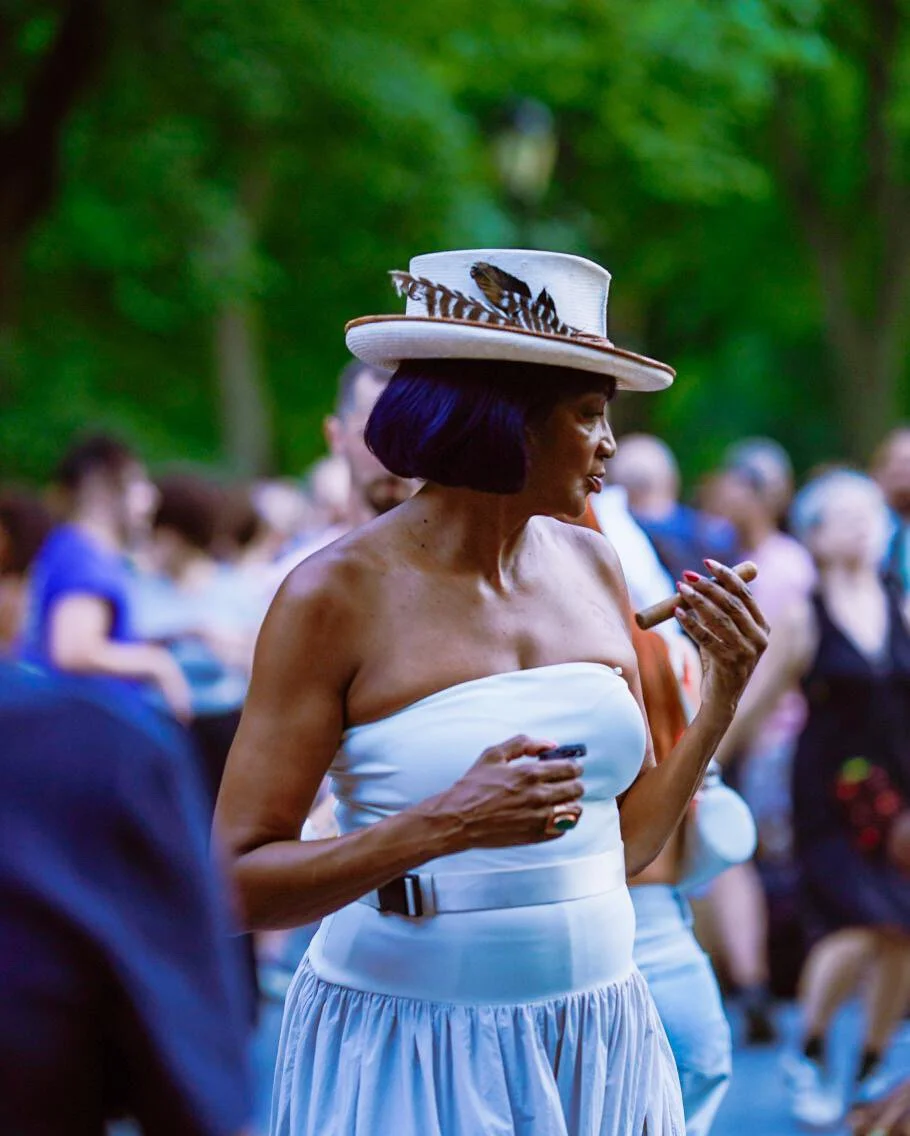
A woman in a white strapless dress and feathered hat holds a cigar & dances among a crowd at a Dance Is Life Party
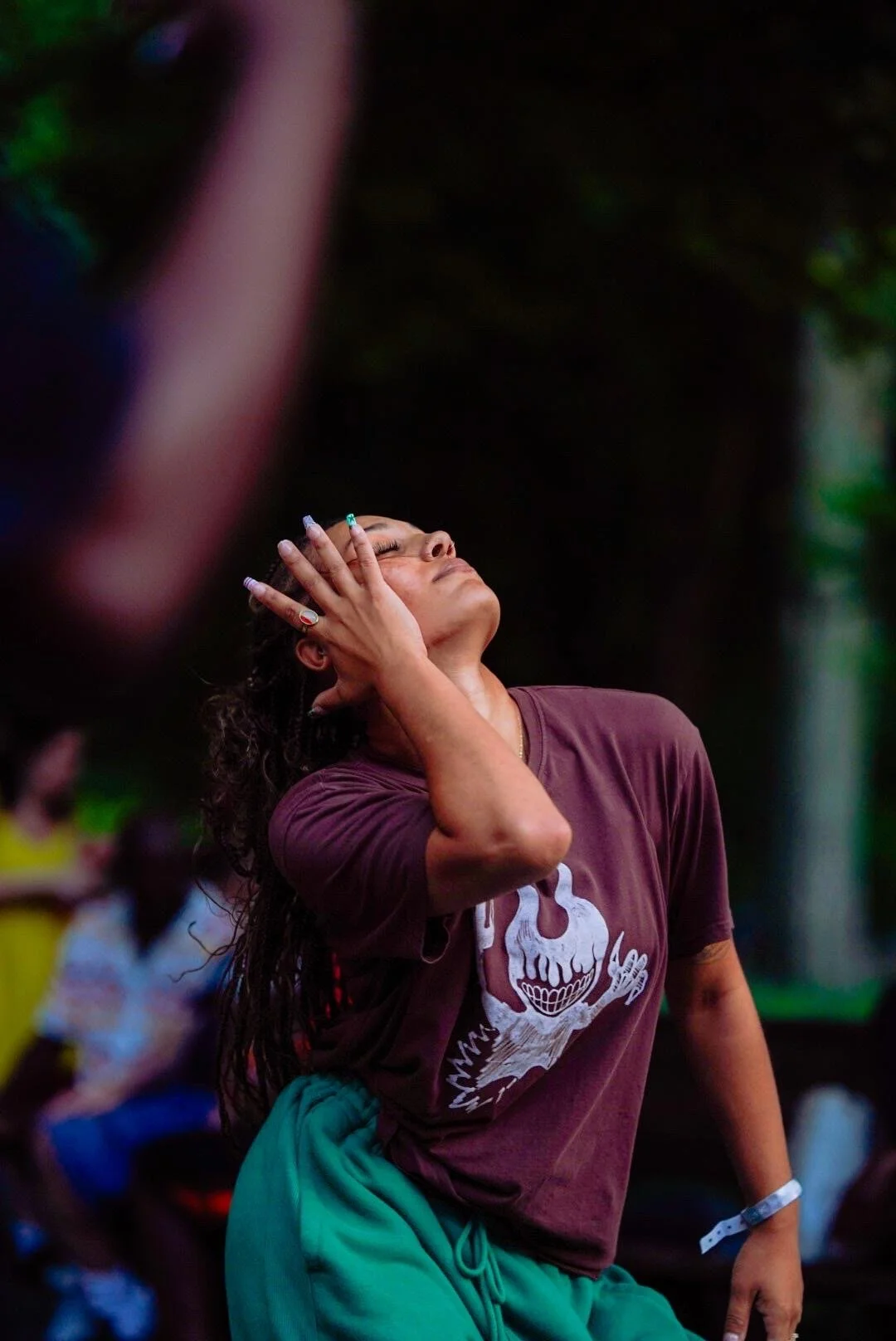
A dancer in a burgundy T-shirt and green pants leans back expressively with one hand raised to their face.
Watching all of this, I felt grateful, and I also felt the limits of my own understanding. I come from a disenfranchised people myself, indigenous people who were murdered, stolen from, and colonized, but I am able-bodied, and I am not Black. With that awareness, I began to interrogate the framework that had felt so clarifying before. If being hopeful is a choice, the implication follows that living in this miserable world built by fascism is also a choice. It is not. Oppression is coercive. Nobody who suffers under the status quo actually chose it.
To be fair, the interview Kaba's quote comes from carries more care than the quote alone can convey. She said that hope is neither an emotion nor optimism, that it leaves room for sadness and anger, that it is more like a decision you renew every morning to keep putting one foot in front of the other. It is work, she says, not a feeling. I respect that framing, and I have genuinely benefited from her writing and her decades of abolitionist organizing, from her insistence on transformative justice to her long fight for collective care to be built into the foundations of public life. She understands, better than almost anyone, what material conditions do to a person's capacity to imagine differently.
Which is exactly why I think the quote, on its own, misses something. An essay I read recently by Decoloniza on grassrootsthinking.com pushed back on this in a way that clarified my own thinking. Hope, the piece argues, requires faith, and faith is the ground beneath both our desires and our expectations. Faith, in turn, relies on power, privilege, and capacity. Under constant systemic abuse, with no real accountability from the institutions producing that abuse, many people lose faith in those institutions entirely, and losing that faith means losing access to hope as Kaba describes it. You cannot discipline yourself into a phenomenon that depends on conditions beyond your control. Community leaders cannot discipline their people into hope without material change underneath it, and the ones who appear to succeed anyway are often teaching a kind of self-regulatory violence, a dismissal of despair and depression and destruction as unproductive feelings obstructing the vision. That dismissal asks people to carry the psychological weight of their conditions alone, through sheer will, while the material world stays exactly as violent as it was.
Reflecting on that essay after what I witnessed last night, I began to think of hope less as a discipline and more as a capability, something that depends on power and position the way any capability does. We were at the Naumburg Bandshell in Central Park, a space where many people who have been pushed out of ordinary society, some pushed literally out of their own homes, now spend their days. Central Park itself exists because of the displacement of the indigenous Lenape people and, later, of the majority-Black settlement called Seneca Village. Black and Latinx dancers gathered in these spaces for decades before they, too, were pushed out. Dance Is Life's mission is a reclamation of that ground and a recreation of the joyful resistance that generations before us made there. Watching people from so many disenfranchised communities dance with abandon on land carrying that history felt like watching the truth of what disability justice organizers have long argued: that the people furthest from power, the ones institutions were never built for, are often doing the most rigorous work of imagining a world that does not yet exist. Disabled people of color, queer people, everyone who has never had the luxury of assuming the system will eventually catch up to them, are frequently the ones generating the frameworks the rest of us eventually borrow. They have always known that dance is a human right, because they are the ones who have had to fight for it. They teach interdependence where the dominant culture preaches self-sufficiency. They build collective access, not individual accommodation. And above all, they insist that safety and care belong to the whole community, never assigned to one heroic figure who is expected to carry it alone.That last part hit close to home, because I organize the Care Team and implement our other safety measures for Dance Is Life, and last night clarified what that work is actually for. Radical care, as I have come to understand it, means building safety that is meaningful and lasting, safety that people can feel in their bodies and rely on, rather than a protocol that exists on paper. This kind of safety is a prerequisite for joy. This is my version of hope: the belief that I can contribute to something that might last beyond me, and maybe even beyond Dance Is Life itself, a model of community care that other spaces and other groups can take up, adapt, and grow. Last night we provided care for hundreds of people with a team of volunteers who are themselves community members and dancers, people who spent part of the evening watching over the crowd and the rest of it moving inside it. Standing among them, I understood that care at this scale takes a whole community, and that it cannot be only my responsibility, no matter how much of myself I want to give it. Whatever hope is, it cannot survive as a solitary discipline.
I am only beginning to understand what some disability justice writers have described as the specific despair of watching antiblack, capitalist, and imperial systems continue to expand, a despair that reflects a clear-eyed reading of the evidence rather than any failure of will. I have not lived that particular history, so I don’t want to claim more understanding than I actually have. What I can say is that the essay's closing argument stayed with me. Despair does not have to be an endpoint. It can serve as a bridge toward a hope so uncontained that it escapes the binary of hope and doomerism altogether. The dark is fertile. It produces light, sometimes entire new worlds, and I believe that is closer to what I watched happen on that dance floor than anything a hopecore video could provide.
Looking around the party, I realized I was seeing what diversity should actually look like. The word usually gets applied to spaces that have been curated for the white gaze while still excluding the people at the deepest margins. At Dance Is Life, those were the people the whole night was built around. You might not see them at the expensive clubs downtown. If you live a life of privilege, they might not look like your friends. They had not found the party through Instagram or an Eventbrite link. The music itself drew them there, a sound announcing that something familiar was happening, something that belonged to them. When they arrived, they found other people who live outside society's neat categories being loud, proud, flamboyant, and unapologetically themselves, and so they stayed. House dancers and hustle dancers moved beside roller skaters swirling around each other. People in drag and every shade of the queer spectrum glittered next to babies in hearing protective muffs and elders in foldable lawn chairs. Everywhere I looked were people in bright colors, lovingly adorned, dressed for themselves and for no one's approval, many wearing clothes they had designed and sewn with their own hands, like costumes. This is what it truly means to fashion oneself: to make your own way because the world offers nothing that suits you.
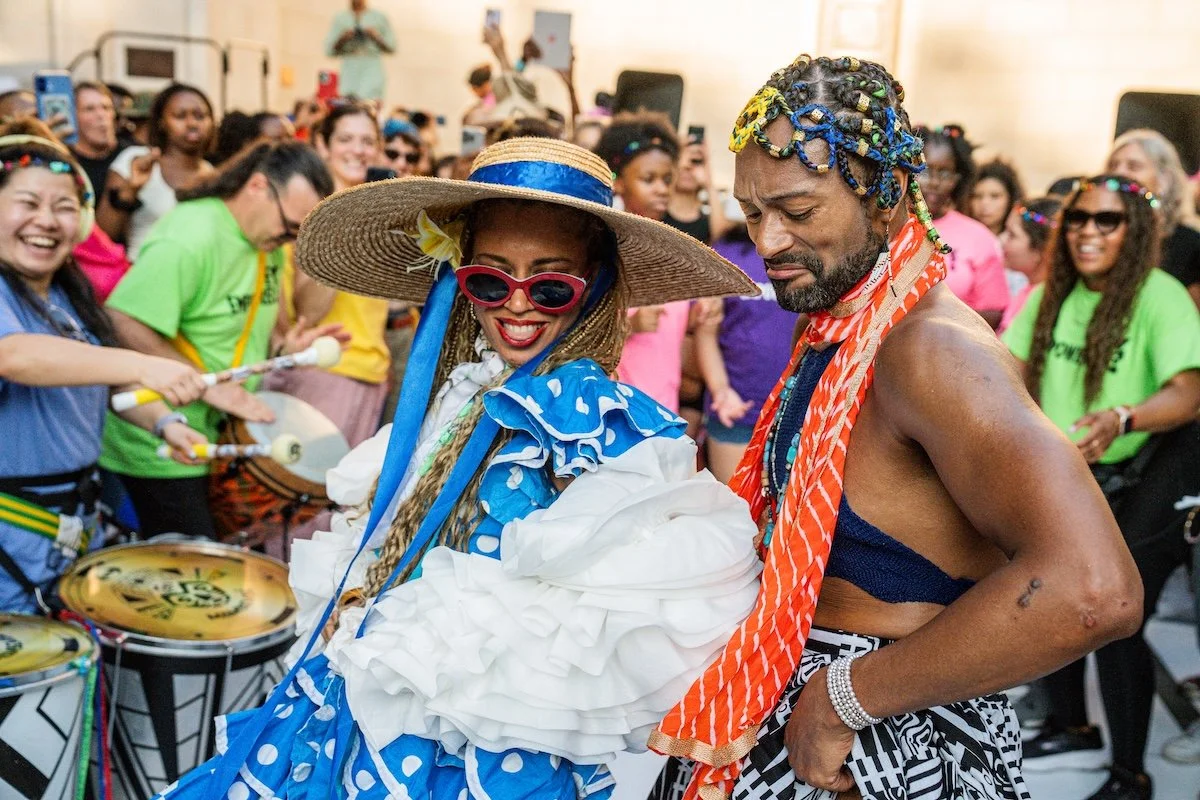
I found myself asking how this party came to be like this. How do you call your people home when they have been kept outside society's basic protections for centuries? Part of the answer is going into the world and being loud about who you are, the way Abdiel and DJ Natasha Diggs, the founders of Dance Is Life, are every time they conjure one of these nights. Refusing to shrink, reclaiming space and joy, being together in spite of the forces that keep us apart, felt like the answer to everything I had been struggling to make sense of about hope and discipline and despair. This is what the world could look like. This is what privilege cannot buy you access to. These are the people already radically reimagining the world, and they are the ones who make hope real, dancing in the pit of despair. We live to see another day.
Dance Is Life founders, Natasha Diggs and Abdiel, dance together in front of a joyful crowd and live drummers. Natasha wears a blue-and-white polka-dot ruffled outfit, a wide-brimmed hat, and red sunglasses, while Abdiel wears a dark blue cropped top, black-and-white patterned pants, and a bright orange scarf.